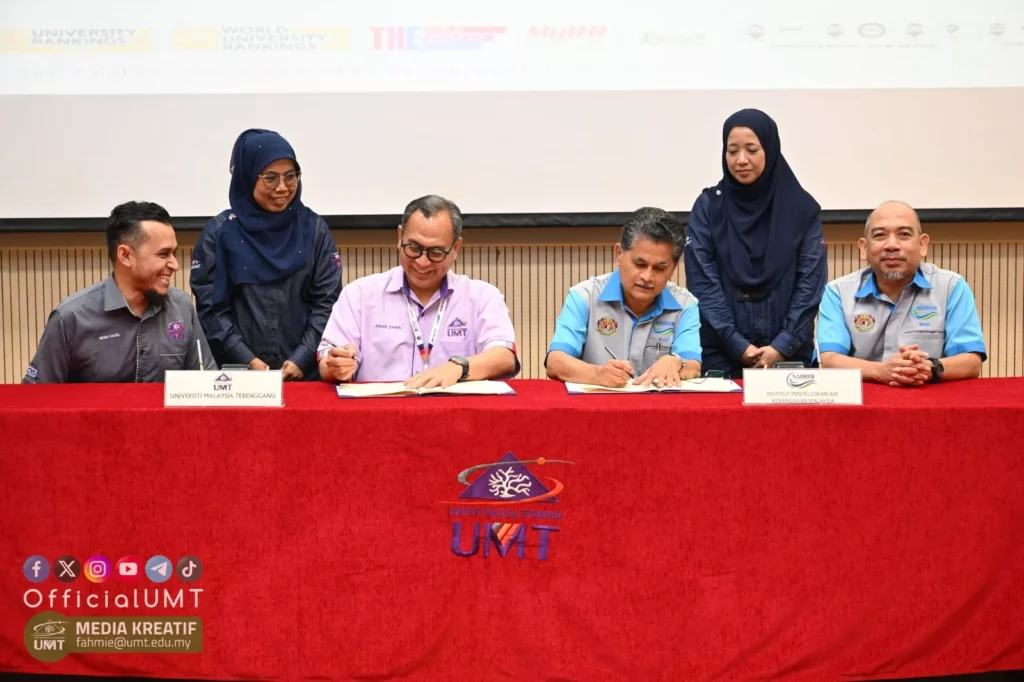
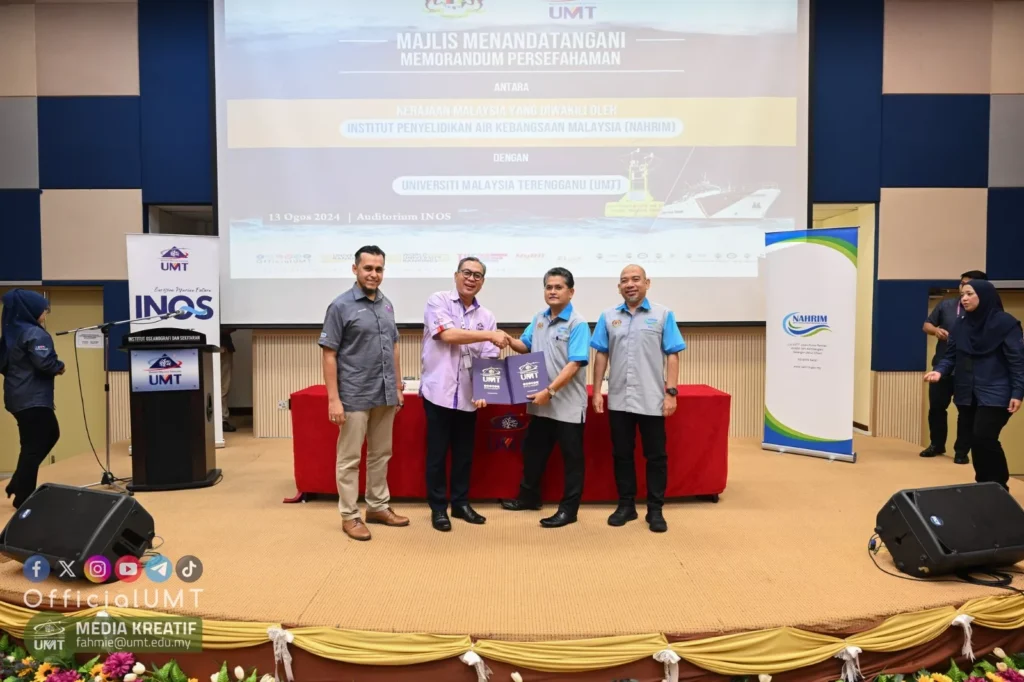
Kuala Terengganu – Universiti Malaysia Terengganu (UMT) and National Water Research Institute of Malaysia (NAHRIM) have signed a Memorandum of Understanding (MoU) to conduct research projects on the environment, especially on the water quality.
The event held at the UMT campus saw UMT Vice Chancellor Prof. Ts. Dr. Mohd Zamri Ibrahim and NAHRIM Director General Ir. Mohd Zaki Mat Amin sign the agreement document, witnessed by representatives from both agencies.
“This collaboration is an important step in an effort to promote environmental sustainability through scientific research and technological innovation,” said Prof. Zamri in his speech in conjunction with the MoU signing at the Institute of Oceanography and Environment Auditorium, UMT.
He added that several research activities will be jointly organized to help the country face the local issues and challenges.
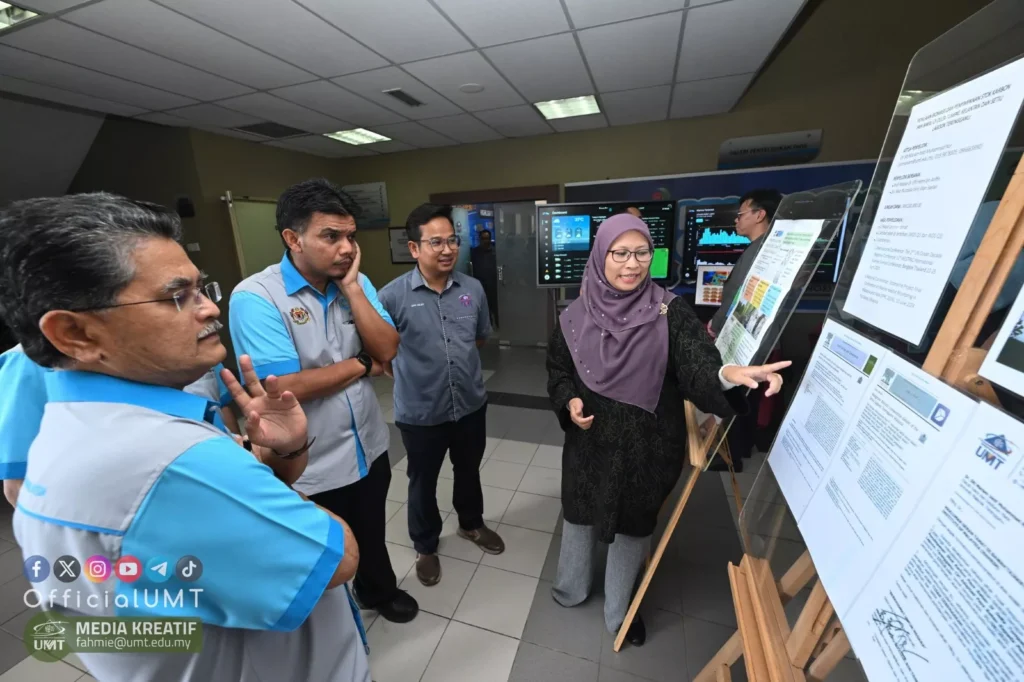
“For the past five years, the collaborative research project between UMT and NAHRIM has aimed to improve the water quality at several areas in Malaysia, including rivers, lakes, and coastal areas affected by pollution and human activities. The project also involves an in-depth study of the water ecosystem, conservation strategies, and new technological development for water monitoring and treatment.
“Among the activities and projects successfully carried out are the study on the impact of sea level rise towards the coastal community, the study on carbon at mangrove areas, the study on river and coastal erosion at several locations in Malaysia, the study on flood and draught threat preparation, the study on microplastic at Malaysian waters, and the study on guidelines for port maintenance in Malaysia.
He added that the expertise from UMT and NAHRIM should be able to come up with effective solutions for improving the quality of the environment and the country’s water resources.
Published by:
Corporate Communications Office
Universiti Malaysia Terengganu