UMT receives
Malaysia’s first advanced WCFC, will strengthen marine research capabilities
Ahad, 15/2/2026
Share This Article :
KUALA NERUS – Universiti Malaysia Terengganu (UMT) continues to strengthen the nation’s marine research capabilities through the acquisition of a high-technology facility, the Wave Circulation Flume Channel (WCFC), positioning the university strategically as a reference centre in the fields of marine and maritime engineering.
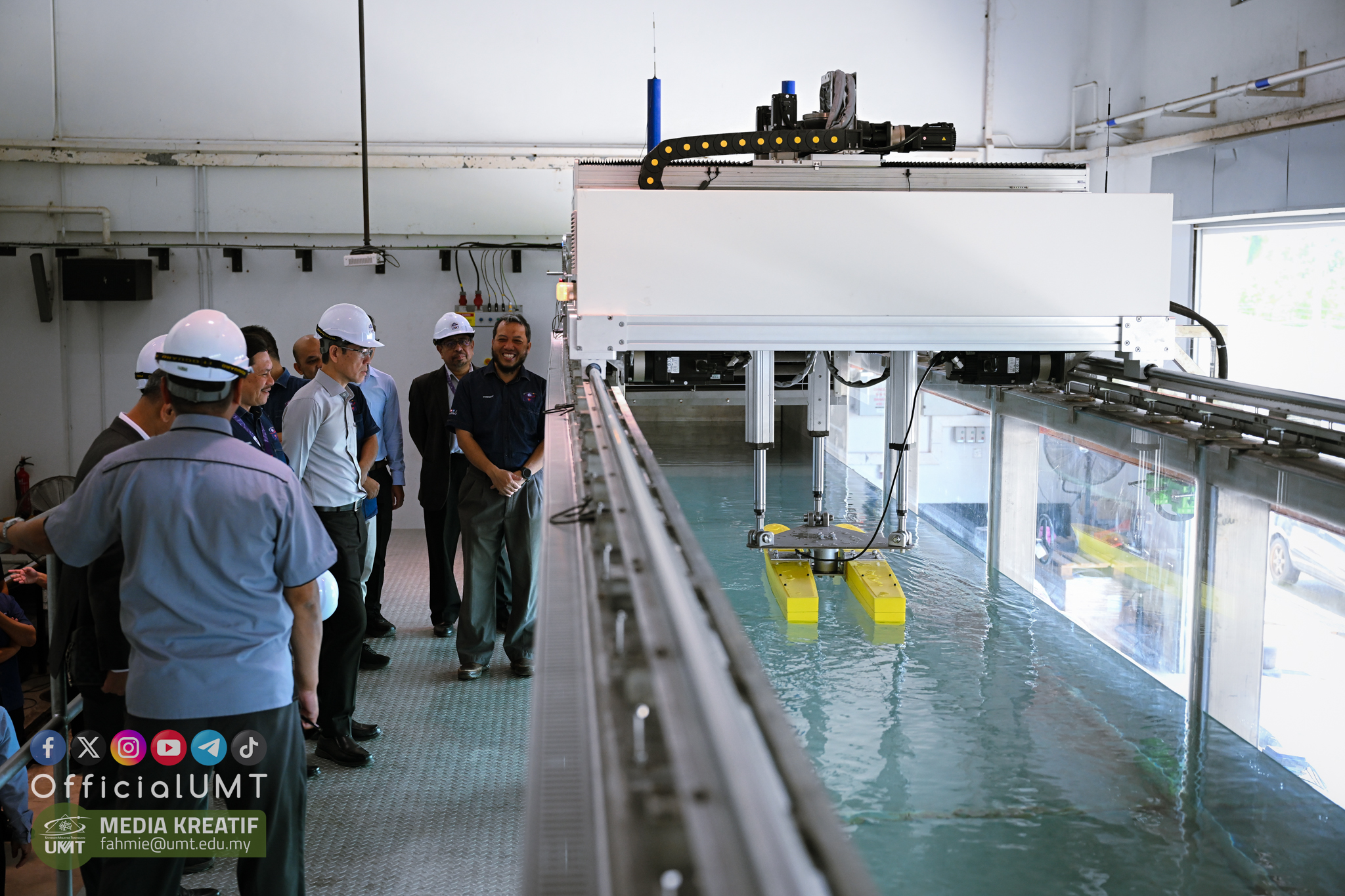
The development was officially announced for the first time during a working visit by the Secretary-General of the Ministry of Higher Education (MOHE), Datuk Dr. Anesee Ibrahim, to the WCFC facility, accompanied by the Deputy Secretary-General of MOHE recently.
The delegation was welcomed by UMT Vice-Chancellor, Prof. Ir. Ts. Dr. Mohd Zamri Ibrahim, together with the University’s Top Management and the Dean of the Faculty of Ocean Engineering Technology (FTKK).
According to Prof. Ir. Ts. Dr. Mohd Zamri, the acquisition of the WCFC asset represents a strategic investment by the university in strengthening the national ecosystem of marine education, research, and innovation.
“This WCFC facility not only enhances UMT’s capacity for high-impact research but also serves as an important platform for producing highly skilled graduates who meet the needs of the maritime and offshore industries,” he said.
He added that the integrated facility also opens broader opportunities for research collaboration with industry, government agencies, and international partners in the fields of marine engineering, coastal engineering, and ocean technology.
The commissioning of the WCFC marks a significant milestone in the development of UMT’s world-class academic and research infrastructure, particularly in marine engineering, science, and technology.
The facility was procured through allocations under the 12th Malaysia Plan (12MP), which focuses on the development of advanced research facilities in line with national needs and future industry challenges.
UMT’s WCFC is the first of its kind in Malaysia, featuring intelligent wave generation, current circulation, wind generation, towing capability, and controlled flow within a single experimental system.
This integrated configuration enables more realistic physical modelling of marine environments, including simulations of regular and irregular waves as well as controllable currents to replicate actual ocean and coastal conditions in a laboratory setting.
From an academic perspective, the facility directly supports teaching and learning for several of UMT’s flagship programmes, including the Bachelor of Applied Science (Maritime Technology), Bachelor of Mechanical Engineering Technology (Naval Architecture), as well as Dual Degree programmes.
In addition, the WCFC is also open for shared use by other faculties and responsibility centres at UMT to encourage interdisciplinary collaboration encompassing engineering, marine sciences, and environmental studies.
In terms of research and consultancy, the facility is capable of supporting studies such as ship resistance testing, Planar Motion Mechanism (PMM) experiments, mooring system analysis, sediment transport, coastal and hydraulic engineering, as well as marine renewable energy research.
UMT regards the commissioning of the WCFC as a major leap forward in the university’s experimental capabilities, further strengthening its role as a centre of excellence in maritime and ocean engineering at both national and international levels.
